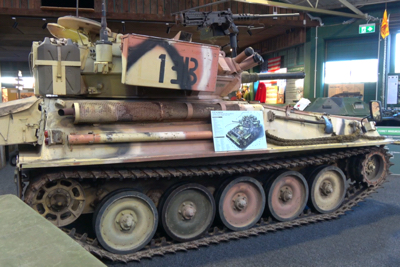
This Daimler Ferret Mk.1 scout car is owned by Mark Cameron, who imported it into New Zealand in the late 2000's after buying it privately from its first civilian owner in the United Kingdom. Mark worked through a massive overhaul over several years, and the Ferret has been in full serviceable condition ever since.
Daimler built 4,409 Ferrets between 1952 and 1971, across sixteen sub-models under various Mark numbers. [1] Power comes from a Rolls-Royce B60 six-cylinder petrol engine driving permanent four-wheel drive through a fluid coupling and a five-speed pre-selective epicyclic gearbox, giving five speeds forward and five in reverse and a factory top road speed near 93 km/h. [1]
Mark reports about 80 km/h on the road and says it handles like a large go-kart, helped by four-wheel independent suspension that is coil sprung all round. At a little over four tons and with a thirsty Rolls-Royce engine, fuel economy is not one of its strong points.
The Ferret's last major British operational use came in the First Gulf War of 1991, during Operation Granby. [2] The interlocking steel plates carried on the front of this car are desert sand mats, a soft-ground aid derived from the pierced steel planking, or Marston Mat, that the United States developed shortly before the Second World War for building temporary runways and vehicle parking areas. [3] Later Ferrets which are seen with mud channels were those that were used those for boggy ground instead.
A black cat on a yellow background is painted on the rear. This is Dick Whittington's cat, a marking associated with a London regiment, though the full unit details are not yet confirmed. These are the markings the car carried when Mark received it. To settle its history, Mark was planning to travel to The Tank Museum at Bovington (Dorset, UK), where service records for British armoured fighting vehicles are held and can be ordered by owners and researchers. [4] Reconnaissance vehicles such as the Ferret are covered by those archives, so the full record of this car should have been relatively straight forward to find.
With the hatches closed, the crew could see out through thick optical viewing blocks set into the hull. These are periscopes, or episcopes, and they're optically correct, so the view appears to run straight through the block even though the sightline is bent up and over the top. This Ferret carries three of them plus a spare.
History
The Ferret was born from a 1947 British Army requirement for a modern reconnaissance vehicle to replace the wartime Daimler Dingo, and the Daimler Company of Coventry won the development contract in October 1948. The first prototype, formally the 'Car, Scout, 4×4, Liaison (Ferret) Mark 1', was delivered in June 1950, and the basic open-topped model carried the designation FV701(C).
It inherited the Dingo's clever "H-drive" layout, in which a central differential prevents the loss of traction that comes from wheel-slip, while parallel drive shafts kept the hull low (roughly the height of a tracked vehicle). Riding on 9.00×16 run-flat tyres, the Ferret could keep moving even after a puncture, and its 4.26-litre Rolls-Royce engine produced 116 bhp in the earliest cars, rising to 129 bhp in later production.
The Mark 1 was a lightly protected machine built for speed and observation rather than a stand-up fight. Its hull is formed from just 6 to 16 mm of steel — enough to shrug off shell splinters, but the basic car is open-topped and was crewed by only two men, a driver and a commander. Armament was modest: every Ferret carries six forward-firing grenade dischargers over the front wheels, normally loaded with smoke, and typically a .303 Bren gun or a pintle-mounted .30 Browning machine gun.
At just 3.84 metres long, 1.91 metres wide and only 1.45 metres tall the car is compact, but still boasts a road range of around 306 kilometres. The sealed-hull Mark 1/1 sub-variant went further still, adding thicker side and rear plates and the ability to ford water.
The type proved enormously popular and long-lived. Counting every mark and experimental type, more than sixty different variants were produced, and the design was exported to around thirty nations, serving on every continent except the Americas. The New Zealand Army itself took delivery of nine Ferrets in 1960–61. Perhaps most remarkably, more than seventy years after that first prototype, the little scout car is still going to war: Ferret Mk.1s have appeared in combat footage from Ukraine in both 2022 and 2025, a fitting testament to the toughness of a vehicle Mark describes as handling like a big go-kart.
A Mark 1 Ferret in us in the Ukraine in 2022. Author Unknown
If you're interested in these types of vehicles, subscribe to our channel, Steel, Steam And Diesel, for more military vehicles, trains, and heavy machinery.
Exclusive Members-Only Content On Our YouTube Channel
If you sign up to be a Member on our Historical Aviation Film Unit channel then you'll have immediate access to this extra material. Click the button at right, then on our channel page click the 'Join' button - it'll help us immensely.