Display At Mosquito Launch Spectacular Show

-
Preserving and Recording Audio-Visual History
Supermarine had planned to produce a two-seat conversion trainer model of the Spitfire from 1941 for fast tracking pilot training but the idea was rejected by the British War Ministry. It wasn’t until 1945 that Vickers Supermarine started the construction of a prototype/demonstration aircraft which lead to 20 Mk.IX airframes being converted to 2-seat trainers.
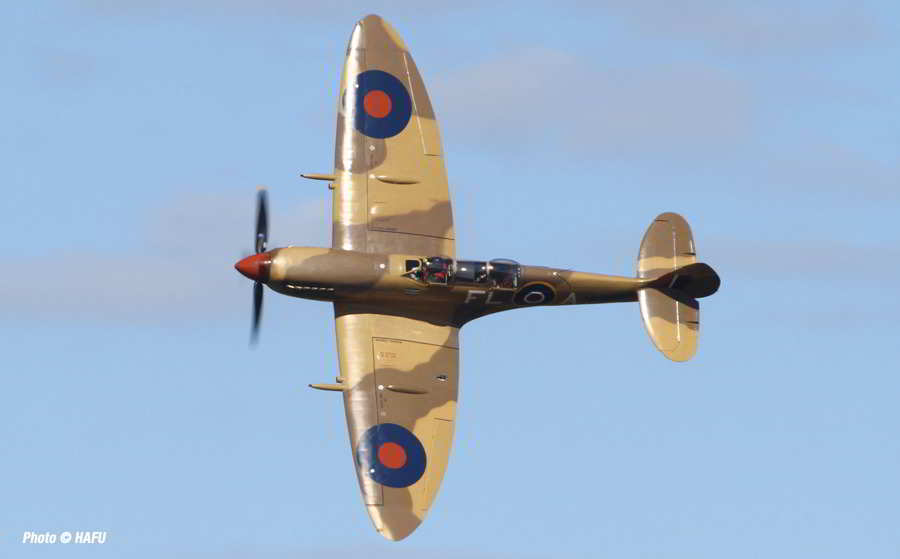
A 'canopy-to-crowd' shot during the RNZAF's 75th Birthday Airshow shows of the fine eliptical lines of the Spitfire wings.
Photo: © Historical Aviation Film Unit
Year: 1936 Built: 22,000+ (5,656 Mk.IX) Serial: MH367 Registration: ZK-WDQ Top Speed: 657 km/h Wingspan: 11.23m Height: 3.58m Length: 9.52m Engine: 1,710hp Packard Merlin 266 V-12 inline Ceiling: 13,106m Range: 2,575km Armament: 2 × 20mm Hispano Mk II cannons and 2 × 0.50in M2 Browning machine guns
MH367 served in Europe and took part in two major airborne (paratroop drop) operations, Market Garden in 1944, and Varsity in 1945. In 1948 it was damaged on landing and deemed surplus to requirments, so was scrapped. Its remains were discovered 40 years later and were incorporated into a two-seat Spitfire project underway at the time in the USA. MH367’s first post restoration flight was in Nov 2006 and was painted in the colours of a Mk. V Spitfire (ER570) flown by Major Robert Levine of the 4th Fighter Squadron, 52nd Fighter Group, United States Army Air Force in Tunisia 1943.
The aircraft was later sold to Doug Brooker and arrived in New Zealand in May 2008 where it was registered as ZK-WDQ (WD-Q was ER570’s squadron code). The aircraft is currently painted in the colours of EN520, an 81 Squadron RAF Spitfire that was flown by New Zealand’s highest scoring ace, Colin Gray, in the North African campaign.
This two-seat Spitfire is available for adventure flights with operator Warbird Adventure Rides for anyone interested in experiencing the feeling of flight in a genuine historic WW2 aircraft - click here for more details.
Doug Brooker displays the Supermarine Spitfire TR.9 (two seater) at the Royal New Zealand Air Force's 75th Birthday Airshow at RNZAF Ohakea, New Zealand
Colin Falkland Gray was the top-scoring Royal New Zealand Air Force ace of World War II. Born on November 9, 1914, in Christchurch (New Zealand), Gray joined the RAF (Royal Air Force) in 1939 and quickly distinguished himself as a skilled pilot. His exceptional skills as a fighter pilot were demonstrated during the Battle of Britain and subsequent air campaigns. Over the course of World War II, he achieved an impressive record, credited with shooting down at least 27 enemy aircraft, a tally which made him the most successful New Zealand-born fighter pilot in the history of the RAF.
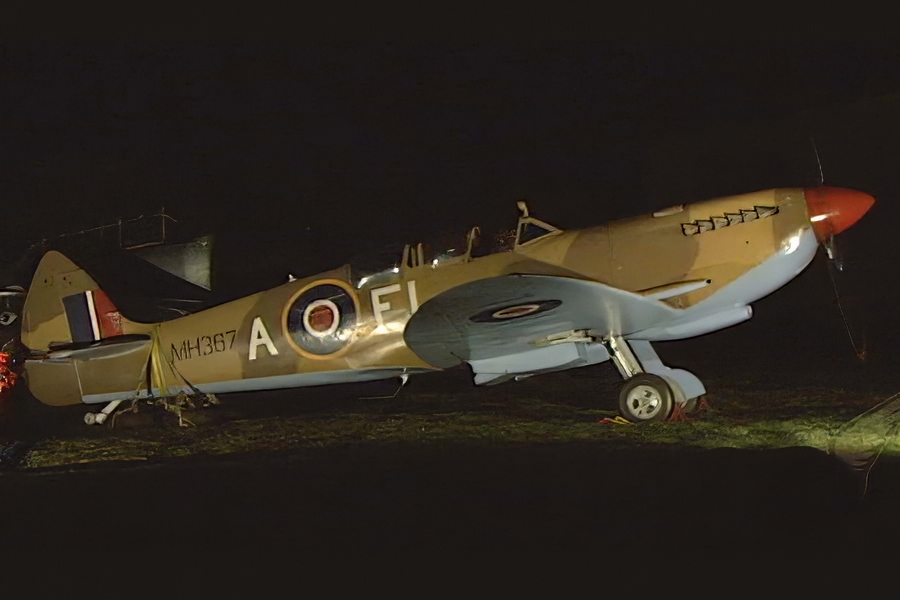
View from of Spitfire during a 'night-run', when the engine is run-up after dark in order to view the exhaust flames. Photo: © Historical Aviation Film Unit
Gray's combat service spanned various theaters of World War II, including the European and Mediterranean fronts. His leadership and flying skills earned him several high honors, including the Distinguished Service Order (DSO) and the Distinguished Flying Cross (DFC) with two bars. After the war, he continued his career in the RAF, serving in various command roles until his retirement in 1961. Following his retirement from the military, he returned to New Zealand, where he remained until his death on August 1, 1995.
More Videos:
Display At Mosquito Launch Spectacular Show
Take-off And Landing Seen From Rear Cockpit
Display At Classic Flyers Airshow In Tauranga
Night Glow To Watch The Merlin Engine Exhaust
More Photos:
Share This Page :
HMTV is our advert-free streaming video channel which features an awesome array of video and long form documentary material which is not available elsewhere. Sign up for a free trial and enjoy the significant and varied range of material we have on offer...
Please consider subscribing to HMTV, or buy us a drink to support our historical (story and film) preservation endeavours.
Copyright © All Rights Reserved — Historical Aviation Film Unit
Template by OS Templates


