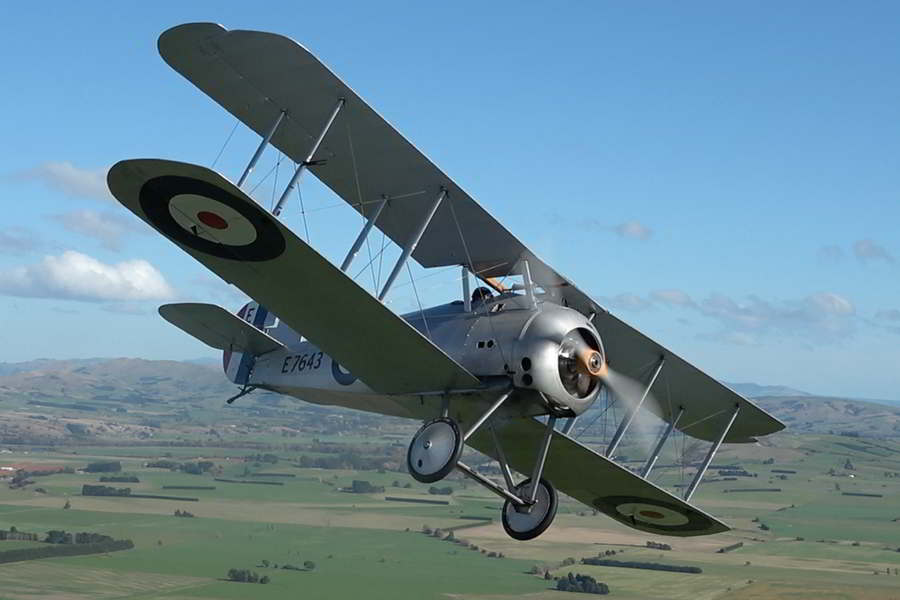
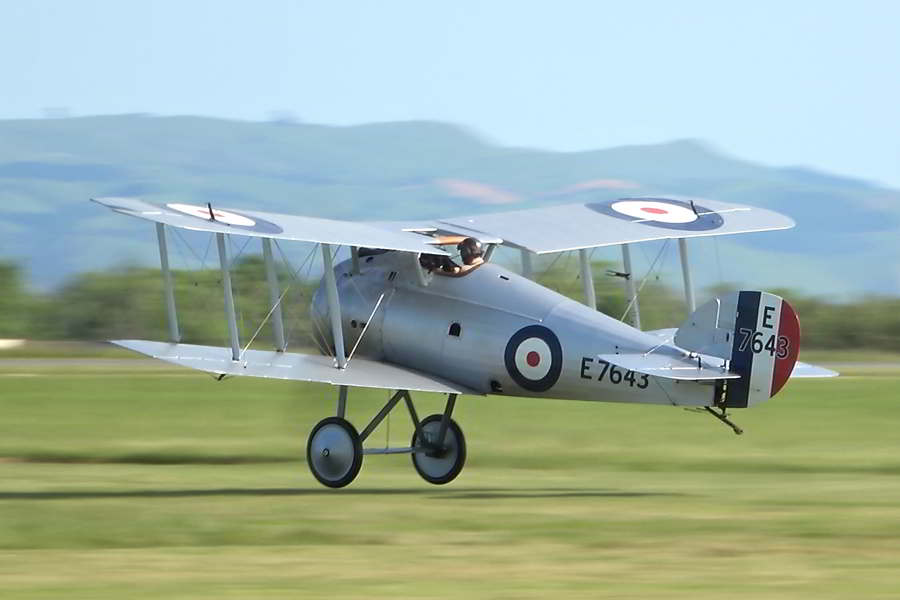
Bentley BR.2 Engine Run In Sopwith Snipe

-
Preserving and Recording Audio-Visual History
Like the earlier Camel, the Snipe was created by Sopwith’s chief designer Herbert Smith, and was intended to be an improvement on its predecessor. Despite making its first flight in October 1917 a number of issues needed correction which delayed the type's introduction and it was not until August 1918 that the Snipe began to arrive in France.
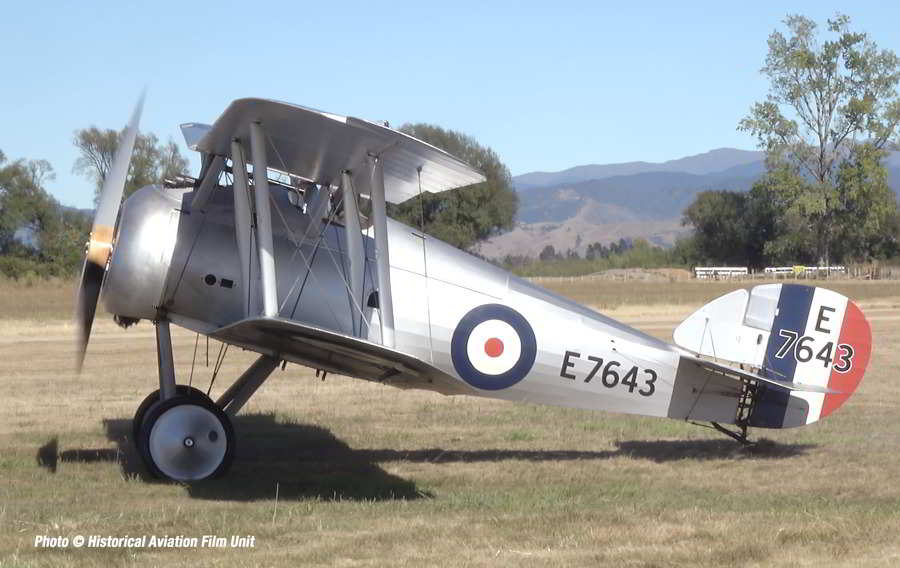
E7643 is a late model Snipe, as identified by the rounded profile of the leading edge of the vertical stabiliser -- early Snipe's had a leading edge with a more distinctive rectangular profile..
Photo: © Historical Aviation Film Unit
Year: 1918 Built: 497 Serial: 0114 Registration: ZK-SBY Top Speed: 195 km/h Wingspan: 9.48m Height: 2.90m Length:6.05m Engine: 230hp Bentley BR.2 rotary Climb:4m/s Ceiling:5,945m Endurance: 3 hours Armament: 2 x 7.7mm (0.303in) Vickers machine guns machine guns and up to 11kg (4x 25lb) bombs
Known contracts for Snipes totalled over 4,515 aircraft, but the number that were eventually built fell well short of that. Rushton Proctor & Co, Nieuport, Sopwith and Boulton Paul were among the companies contracted to build the new aircraft. It’s known that 497 Snipes had passed final inspection by the end of 1918, but it seems that some of the contractors continued to build aircraft until as late as March 1919. At least 1,567 Snipes are known to have been delivered under the production contracts, but how many more were partially built or simply built but not delievered is unknown.
This TVAL reproduction aircraft is in the scheme of a Snipe operated by No 56 Sqn RAF between Feb 1920 and 1924. In that period the unit operated at least four Ruston Proctor-built airframes including E7639 and E7647, which suggests one can safely assume that E7643 was built and delivered before the formal cessation of production. 56 Sqn was disbanded in Sept 1922, but one flight was hastily reformed several days later and was sent to the city of Constantinople (now Istanbul) to help stave off a new war with Turkey, where it remained until August 1923.
Video of The Vintage Aviator's first Sopwith Snipe -- an early version with the rectangular leading edge on the vertical stabliser.
The Sopwith Snipe was renowned for its exceptional performance at high altitudes, a critical advantage in aerial combat during World War I. It was powered by a Bentley BR2 rotary engine, which gave it an edge over many of its contemporaries in terms of speed and agility at higher altitudes. This capability allowed pilots to engage enemy aircraft with greater effectiveness above the trenches of the Western Front.
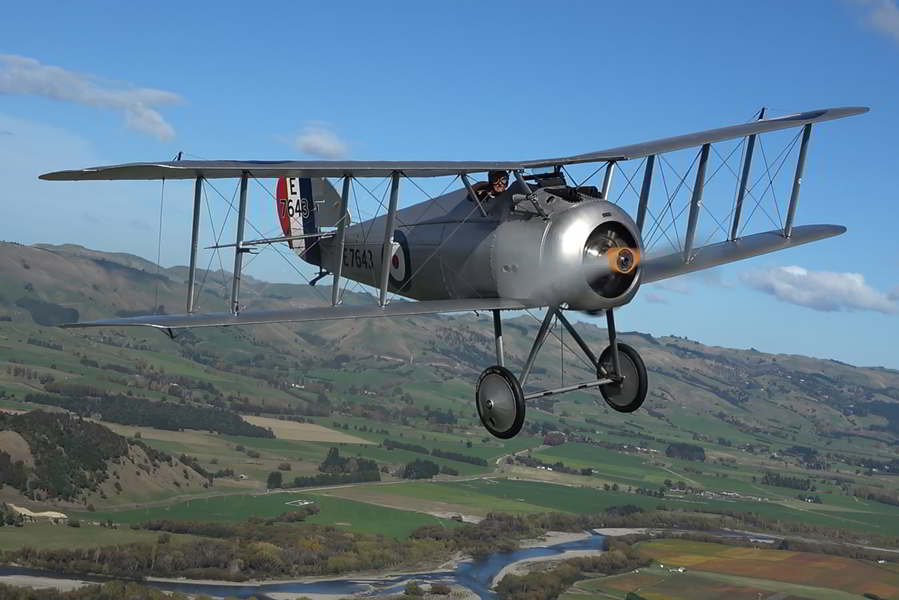
View of the Snipe in its natural environment in the air, over the Wairarapa landscape. Photo: © Historical Aviation Film Unit
The Snipe holds a distinct place in aviation history as it marked the end of the era of rotary-engine fighter aircraft. Its introduction in 1917 came at a time when aircraft technology was rapidly evolving and the type's design and performance represented the pinnacle of rotary-engine fighter technology. However, it was soon outclassed by newer, more advanced aircraft with inline engines, which offered better performance, efficiency, and reliability. Despite this, the Sopwith Snipe's contribution to the RAF and its role in World War I remains a significant chapter in military aviation history.
More Videos:
Bentley BR.2 Engine Run In Sopwith Snipe
Early Sopwith Snipe Display At Hood Aerodrome
Sopwith Snipe Air To Air Video
Bristol Fighter F.2b And Sopwith Snipe On Patrol
More Photos:
Share This Page :
HMTV is our advert-free streaming video channel which features an awesome array of video and long form documentary material which is not available elsewhere. Sign up for a free trial and enjoy the significant and varied range of material we have on offer...
Please consider subscribing to HMTV, or buy us a drink to support our historical (story and film) preservation endeavours.
Copyright © All Rights Reserved — Historical Aviation Film Unit
Template by OS Templates