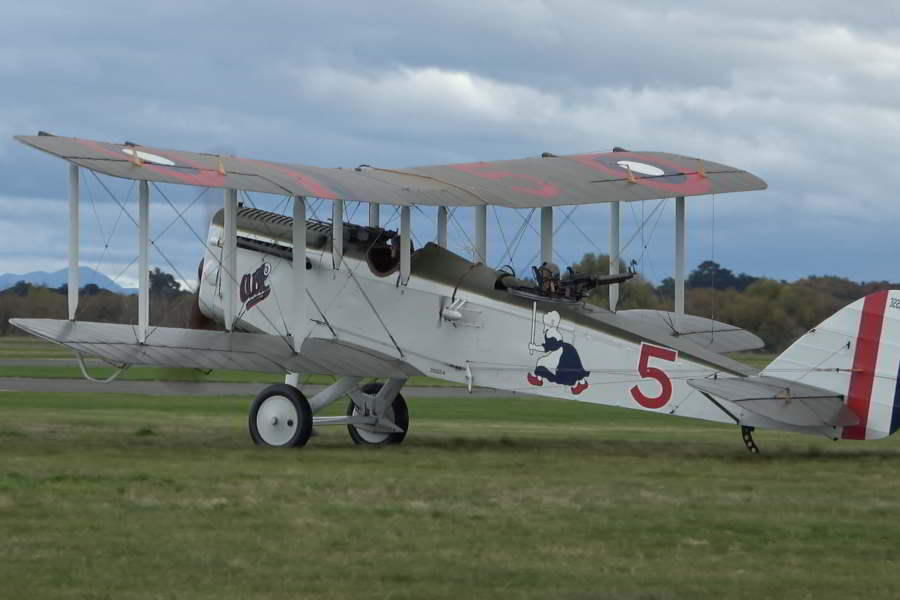
Flying From The Rear Seat

-
Preserving and Recording Audio-Visual History
The DH.4 was initially designed by Geoffrey de Havilland for Airco (Aircraft Manufacturing Company) as the first British two-seat light bomber with an effective defensive armament. The type entered service with the Royal Flying Corps in March 1917, and many aircraft of the type remained in service with the United States Army Air Force until as late as 1932.
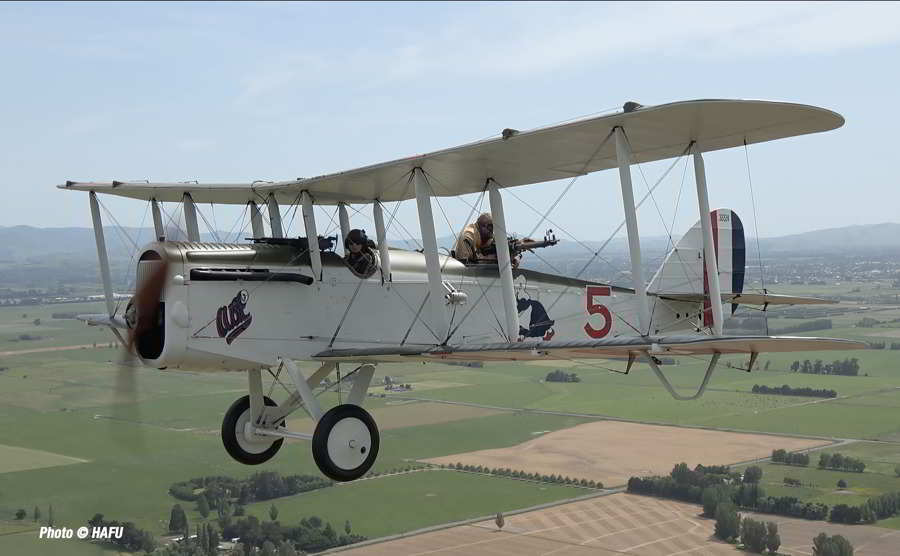
The DH.4 on a routine patrol over the lines.
Photo: © Historical Aviation Film Unit
Year: 1917 Built: 6,295 (4,846 in USA) Registration: ZK-DHA Top Speed: 230 km/h Wingspan: 13.21m Height: 3.35m Length: 9.35m Engine: Rolls-Royce Eagle VII inline or Liberty V-12 for US variants Ceiling: 10,820m Armament: 1 x Vickers machine gun (forward )plus 1 or 2 x 7.7mm (0.303) Lewis for observer/gunner with provision for 210kg (460lb) of bombs This Aircraft: A replica airframe with an original V-12 Liberty engine.
America entered World War One on the 6th April 1917, and surprisingly, she did so without owning a single combat-worthy aircraft. Not only that, but the aircraft production industry in the US was also seriously under-prepared for war, and there were not even any American designs for combat aircraft on the drawing board.
The only answer that would allow for the rapid expansion of the air combat wing was to build aircraft that were already being produced in Europe, under licence. The selected candidates were the French Spad XIII, and the British designed R.A.F. S.E.5a, the Bristol F.2b and the de Havilland (Airco) D.H.4.
During its early wartime service a number of different aero engines were used in the aircraft as the preferred Rolls Royce Eagle VII's were in short supply. Eventually the bulk of the type (built in the USA by de Havilland) were powered with the US-designed 400hp Liberty L-12 engine.
This replica de Havilland DH-4 is owned and operated by The Vintage Aviator Collection in New Zealand. The aircraft began life in the USA, making it an appropriately genuine American-built replica, and it was completed to airworthy status by TVAL upon it's arrival in New Zealand.
This aircraft is in the colour scheme of the 50th Aero Squadron, US Army Air Force. Formed in August 1917, the 50th's primary role was observation and reconnaissance, and their first operations in France were in early September 1918. During their two months long stint at the front before the end of the war, the 50th flew 343 missions and encountered enemy aircraft on 42 occasions (at least one of which was confirmed shot down). The unit eventually returned to the USA in April 1919.
The 'Dutch Girl' logo on the side of the aircraft was originally taken from a popular cleaning product called Old Dutch Cleanser, and represented the motto of the 50th Aero which was "Cleaning up on Germany".
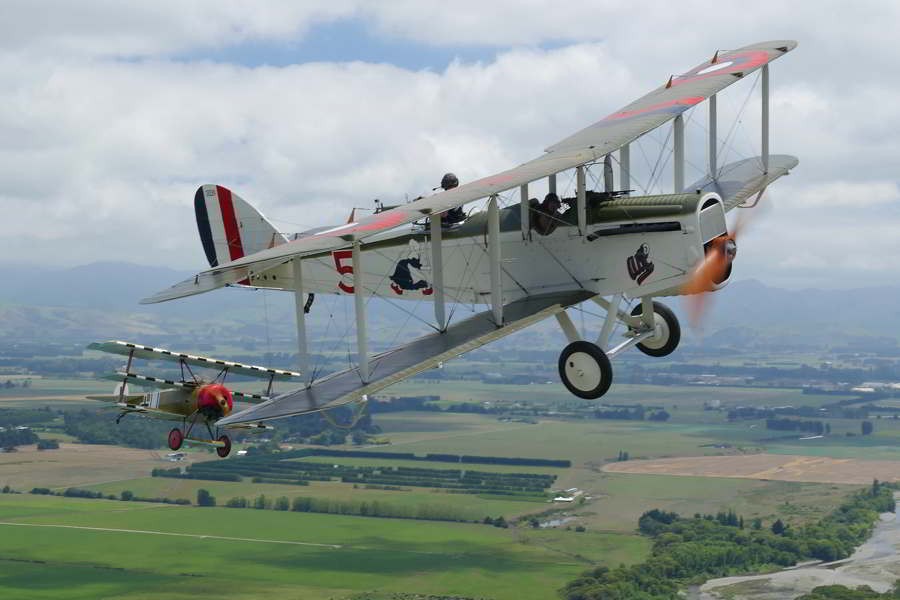
The DH.4 is attacked by a German Fokker Dr.1 Triplane. Photo: © James Fahey
The New Zealand Permanent Air Force operated DH.4s from 1919 to 1929 which were generally used as advanced training aircraft. A DH.4 broke the New Zealand altitude record of 21,000 ft (6,400 m) on 27 November 1919, and on the 8th September one of the aircraft had the distinction of being the first aircraft to fly over Mount Cook .
Not many people know that it was possible to pilot (at least some) de Havilland DH.4 bombers from the rear gunner's seat during the First World War. Many two-seater aircraft had some form of rudimentary control in the gunners cockpit, but the DH.4 has a full suite of pilot controls available in that rear position.
See the extra video below, in which Hayley Vincent, a young military aviator, discovers and then discusses, what it's like to fly a World War One aircraft from the gunner's position, and provides some interesting insights into the difficulties that even a vaguely experienced gunner would face when trying to pilot his (her) machine.
More Videos:
Flying From The Rear Seat
360º Video Of A Takeoff
More Photos:
Share This Page :
HMTV is our advert-free streaming video channel which features an awesome array of video and long form documentary material which is not available elsewhere. Sign up for a free trial and enjoy the significant and varied range of material we have on offer...
Please consider subscribing to HMTV, or buy us a drink to support our historical (story and film) preservation endeavours.
Copyright © All Rights Reserved — Historical Aviation Film Unit
Template by OS Templates