B.E.2f and B.E.2c Together

-
Preserving and Recording Audio-Visual History
The original "Blériot Experimental 2" was designed in 1912 by Geoffrey de Havilland and was the first British aircraft designed specifically for military use. While Louis Blériot had been designing aircraft for some time, these Royal Aircraft Factory aircraft had no connection with his designs -- the naming convention was simply designed to indicate that they were general purpose two-seat tractor biplanes (with engines at the front).
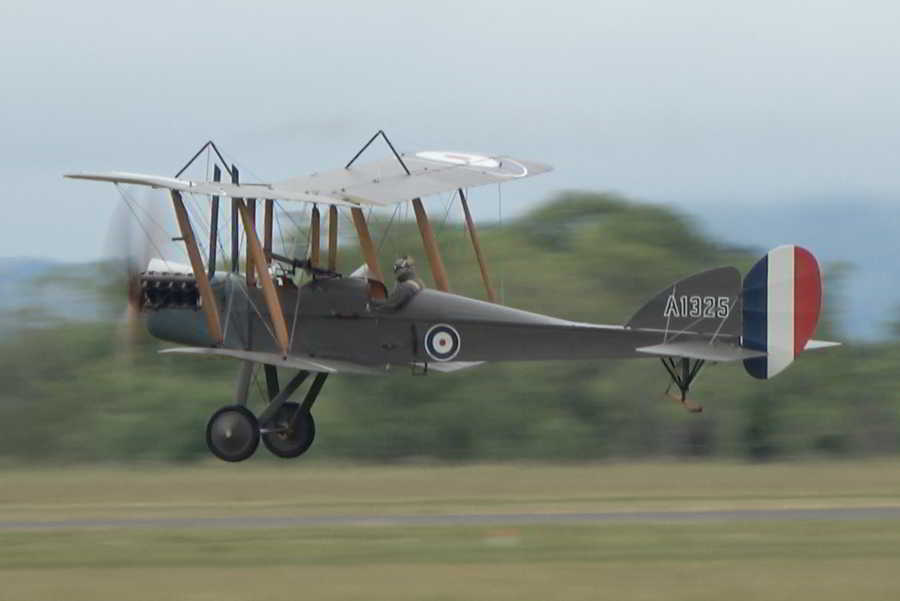
Royal Aircraft Factory B.E.2f, as A1325, in a generic Royal Flying Corps colour scheme.
Photo: © Historical Aviation Film Unit
Year: 1916 Built: 3500+ (all B.E.2 variants) Top Speed: 132 km/h Ceiling: 3,048m Wingspan: 12.42m Height: 3.66m Length: 8.31m Engine: 90hp R.A.F.1a air cooled V-8 Range: 320km Endurance: 240 mins Armament: 1 or 2 x .303 Lewis with up to 102kg bombs This Aircraft: A TVAL-restored original airframe with a new TVAL-built 90hp R.A.F.1a engine reproduction.
The first B.E.2s were delivered to the RFC in 1913, and by the outbreak of war in July 1914 they were in service with three squadrons. The design was inherently stable, and while this made them easy to fly and well-suited for observation and artillery spotting, it also made them virtually helpless against the more maneuverable German fighters (particularly the Fokker E.III). Additionally the back-to-front seating arrangement where the observer sat in the front, between the two wings and amongst the rigging, usually made it difficult for him to bring his guns to bear on any opponents.
The RAF B.E.2f was a variant of the B.E.2 series, and was a development of the earlier B.E.2c and B.E.2e models. The B.E.2f incorporated several refinements aimed at enhancing its performance and operational capability, such as wings of unequal span and a single pair of interplane struts. Some older B.E.2c aircraft (previously with wings of equal span) were converted to this new variant, and they were also designated the B.E.2f. These changes did little to enhance the combat effectiveness of the aircraft.
The newly restored Royal Aircraft Factory B.E.2f (A1325) makes it's public display debut at Classic Fighters 2009 at Omaka Aerodrome (Blenheim, NZ)
Despite the type's shortcomings, the B.E.2f played a crucial role in the development of aerial reconnaissance and bombing techniques. Its stable flight characteristics made it an excellent platform for aerial photography and reconnaissance missions, contributing valuable intelligence to the Allied war effort. However, as the war progressed and aerial combat became more intense, the B.E.2f's lack of speed and maneuverability led to it being outmatched by enemy fighters, resulting in high casualty rates among its crews and by the end of the war most B.E.2s were relegated to a training role only.

Coming in to land at Hood Aerodrome, Masterton, NZ Photo: © Historical Aviation Film Unit
This aircraft (A1325) is one of 17 Royal Flying Corps veteran aircraft shipped to Norway in 1917 and is a genuine World War One survivor. The aircraft was restored by The Vintage Aviator Ltd, and made its maiden post-restoration flight in 2009.
More Videos:
B.E.2f and B.E.2c Together
B.E.2f At Wings Over Wairarapa
More Photos:
Share This Page :
HMTV is our advert-free streaming video channel which features an awesome array of video and long form documentary material which is not available elsewhere. Sign up for a free trial and enjoy the significant and varied range of material we have on offer...
Please consider subscribing to HMTV, or buy us a drink to support our historical (story and film) preservation endeavours.
Copyright © All Rights Reserved — Historical Aviation Film Unit
Template by OS Templates


